1Tongji University 2vivo Mobile Communication Co., Ltd. 3Nanjing University 4State Key Laboratory of Autonomous Intelligent Unmanned Systems; Frontiers Science Center for Intelligent Autonomous Systems, Ministry of Education
We introduce a continuous Neural Image Field (NIF) representation and make it generation-aware through SRG and CQAR, bridging the reconstruction–generation gap and enabling high-quality image synthesis at arbitrary resolutions.
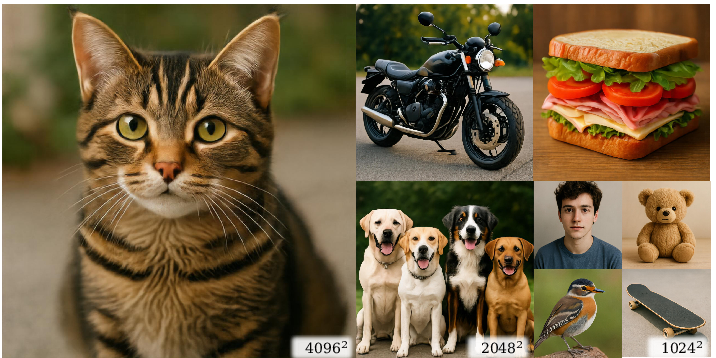
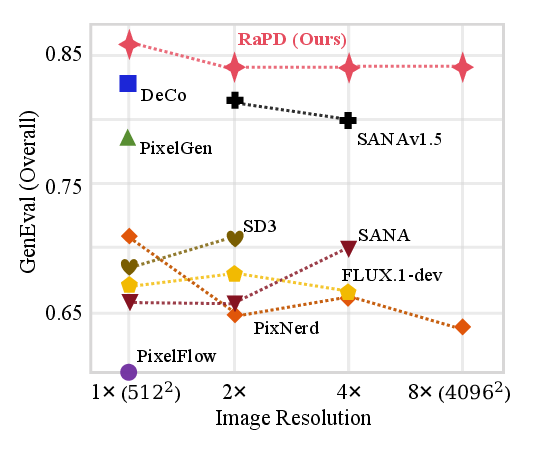
Left: RaPD generates high-quality images at multiple resolutions. Right: RaPD achieves state-of-the-art GenEval performance across resolutions.
0.86GenEval · 512 × 512
82.9DPG-Bench · 512 × 512
1.1BDenoiser parameters
2.13 s4096 × 4096 · B200
Gallery
Abstract
Natural images are continuous, yet most generative models synthesize them on discrete grids, limiting resolution-flexible generation. Continuous neural fields enable resolution-free rendering, but prior methods introduce continuity only at the decoding stage as an interpolation module, leaving the generative latent space discretized and reconstruction-oriented. We propose RaPD (Resolution-agnostic Pixel Diffusion), which performs diffusion in a continuous Neural Image Field (NIF) latent space. RaPD bridges this reconstruction–generation gap with Semantic Representation Guidance for generation-aware latent learning and a Coordinate-Queried Attention Renderer for coordinate-conditioned, scale-aware rendering. A single denoised latent can be rendered at arbitrary resolutions by changing only the query coordinates, keeping diffusion cost fixed. Experiments demonstrate superior generation quality and resolution scalability.
Motivation: Can one generated representation support different output resolutions?
Both VAE latents and pixel tokens use discrete grids, requiring more denoising tokens and computation at higher output resolutions. RaPD generates one continuous Neural Image Field (NIF) and renders it at different resolutions by changing the query coordinates, keeping diffusion cost fixed.
From discrete VAE latents and pixel tokens to a continuous Neural Image Field, queried at arbitrary spatial coordinates.
The reconstruction–generation gap
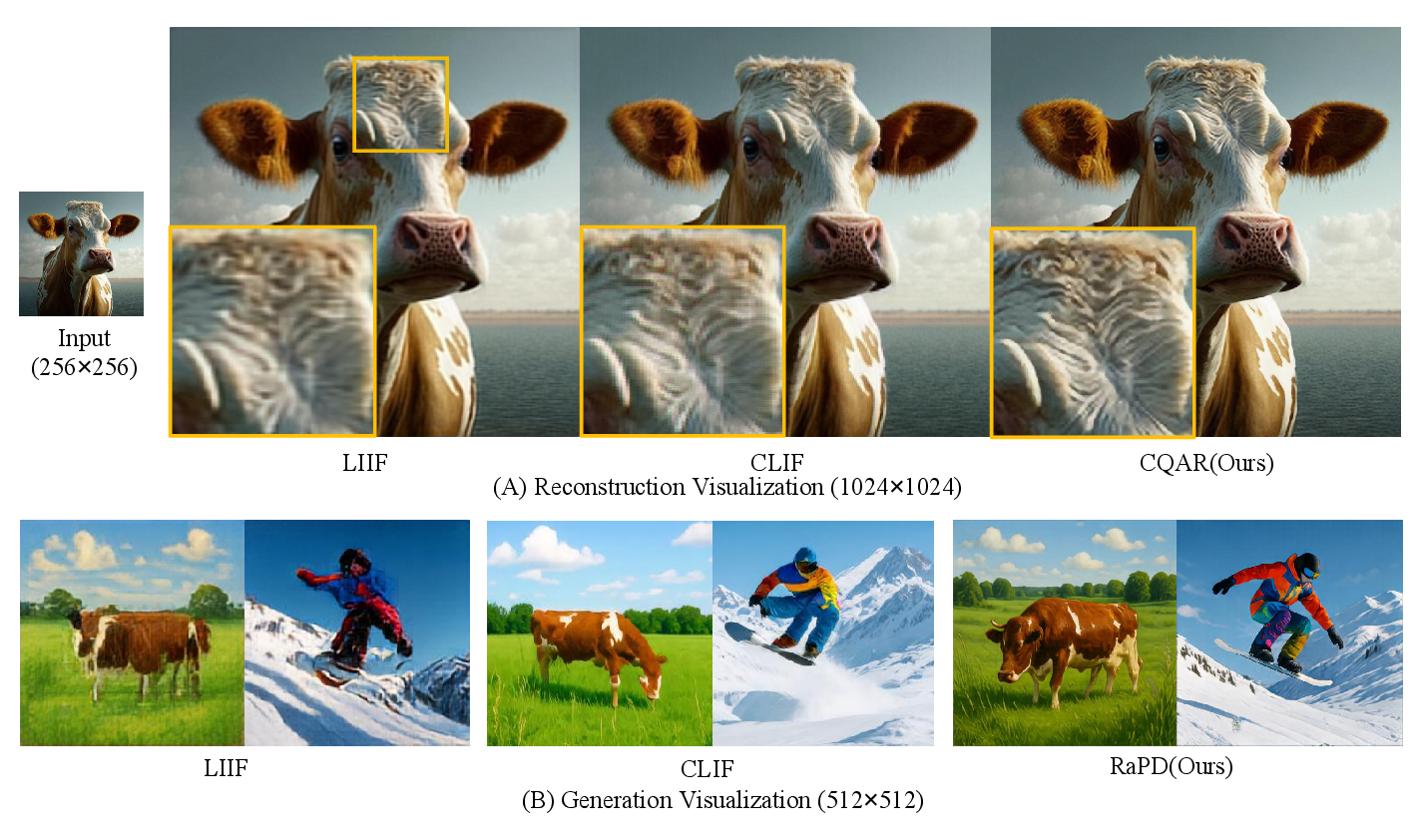
However, the continuous NIF representations learned for reconstruction are not automatically generation-ready. Reconstruction-trained LIIF and CLIF latents can preserve low-level texture while lacking the semantic structure needed by a diffusion model.
The reconstruction–generation gap in existing Neural Image Field representations.
Method: RaPD makes NIF generation-ready with SRG and CQAR
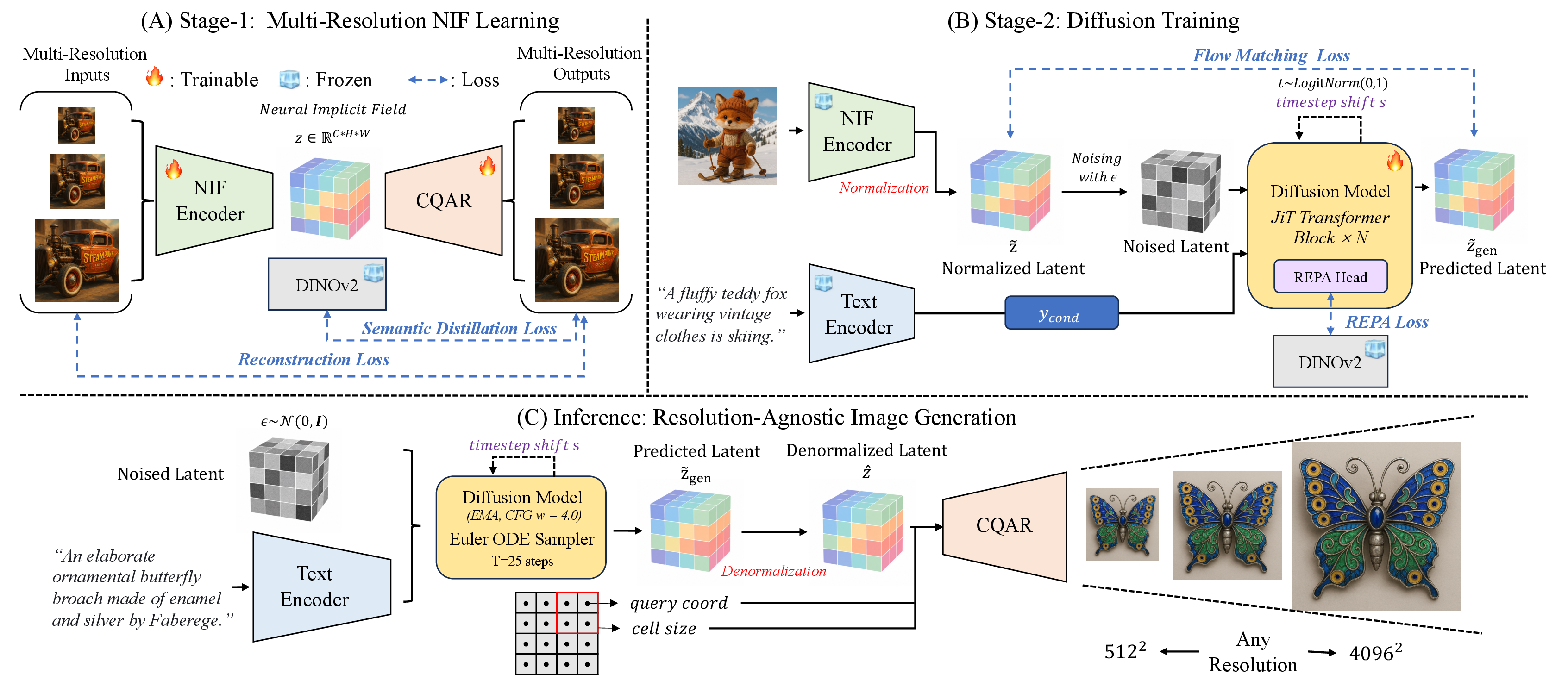
Stage 1: semantically guided multi-resolution NIF learning. Stage 2: text-conditioned flow matching. Inference: query one denoised latent at arbitrary resolutions.
01 / Semantic Representation Guidance
Semantic Distillation
In Stage 1, pooled and projected NIF features learn from a frozen DINOv2 teacher. The distillation loss aligns features at each spatial position and preserves pairwise similarity relationships, while leaving the original latent layout unchanged.
ℒdistill = ℒmcos + ℒmdms
ℒmcos aligns local features using a cosine-similarity margin; ℒmdms aligns pairwise similarity matrices using a distance margin.
Latent-Density-Aware Timestep Shift
In Stage 2, timestep shifting adapts flow-matching training to the dense NIF latent. A larger shift factor emphasizes noisier states; RaPD uses s = 32.
t₀ = sigmoid(ξ), ξ ∼ 𝒩(0, 1) t = t₀ / [t₀ + (1 − t₀)s], s = 32
02 / Coordinate-based rendering
Render beyond a fixed grid
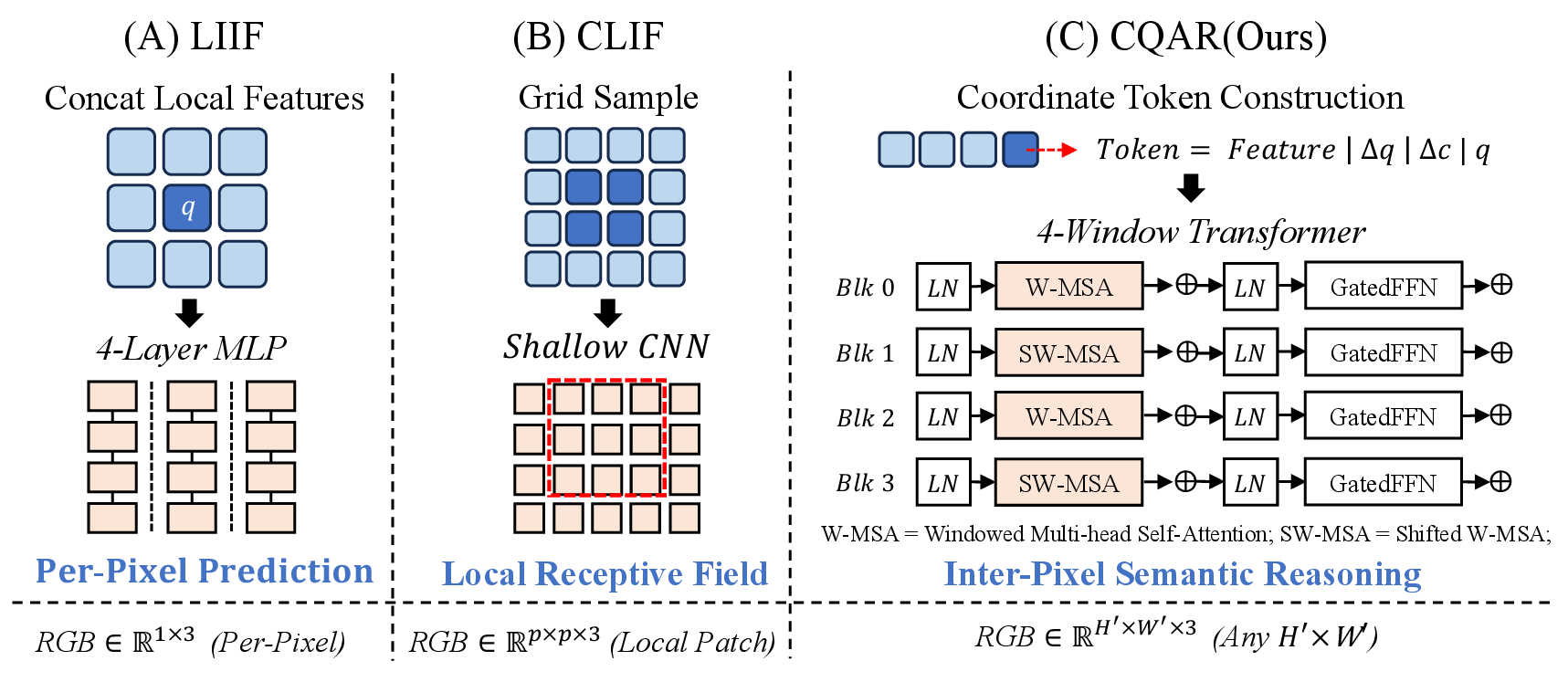
CQAR is a coordinate-conditioned, scale-aware renderer. It uses attention to support interaction between output tokens. Changing the query coordinate grid changes the output resolution without rerunning diffusion.
Decoder comparison: LIIF uses a per-pixel MLP; CLIF uses a shallow CNN; CQAR introduces coordinate-conditioned attention.
Generation results
Text-to-image evaluation at 512 × 512. Higher scores are better.
GenEval
Method
Params
Single
Two
Counting
Colors
Position
Color attr.
Overall
LDM
1.4B
0.92
0.29
0.23
0.70
0.02
0.05
0.37
SD3
8B
0.98
0.84
0.66
0.74
0.40
0.43
0.68
FLUX.1-dev
12B
0.99
0.81
0.79
0.74
0.20
0.47
0.67
SANA
1.6B
0.99
0.79
0.63
0.88
0.18
0.47
0.66
PixelFlow-XL/4
0.9B
--
--
--
--
--
--
0.60
PixNerd-XXL/16
1.2B
0.97
0.86
0.44
0.83
0.71
0.53
0.73
DeCo-XXL/16
1.1B
1.00
0.92
0.72
0.91
0.80
0.79
0.86
PixelGen-XXL/16
1.1B
0.99
0.88
0.59
0.90
0.70
0.70
0.79
PixNerd-XXL/16 (‡)
1.2B
0.98
0.82
0.43
0.81
0.66
0.55
0.71
DeCo-XXL/16 (‡)
1.1B
0.99
0.92
0.65
0.91
0.71
0.77
0.83
PixelGen-XXL/16 (‡)
1.1B
0.99
0.88
0.58
0.91
0.70
0.67
0.79
RaPD
1.1B
0.99
0.93
0.72
0.93
0.77
0.74
0.85
RaPD (256→512)
1.1B
0.99
0.93
0.77
0.92
0.79
0.78
0.86
DPG-Bench
Method
Params
Global
Entity
Attribute
Relation
Other
Average
SD v2
0.9B
77.7
78.1
74.9
80.7
80.7
68.1
PixArt-α
0.6B
75.0
79.3
78.6
82.6
77.0
71.1
SANA
1.6B
90.3
91.2
89.0
88.9
92.0
85.5
PixelFlow-XL/4
0.9B
--
--
--
--
--
77.9
PixNerd-XXL/16
1.2B
80.5
87.9
87.2
91.3
72.8
80.9
DeCo-XXL/16
1.1B
--
--
--
--
--
81.4
PixNerd-XXL/16 (‡)
1.2B
87.2
87.1
88.9
87.1
89.8
81.5
PixelGen-XXL/16 (‡)
1.1B
81.4
88.8
86.7
88.9
88.9
80.4
DeCo-XXL/16 (‡)
1.1B
88.6
88.4
88.9
87.6
86.0
81.2
RaPD
1.1B
85.1
87.7
88.9
89.6
84.1
81.6
RaPD (256→512)
1.1B
81.3
89.9
89.7
88.9
81.2
82.9
‡ Officially released models evaluated with the same random seed and computing environment as RaPD. Progressive RaPD uses 256 → 512 training.
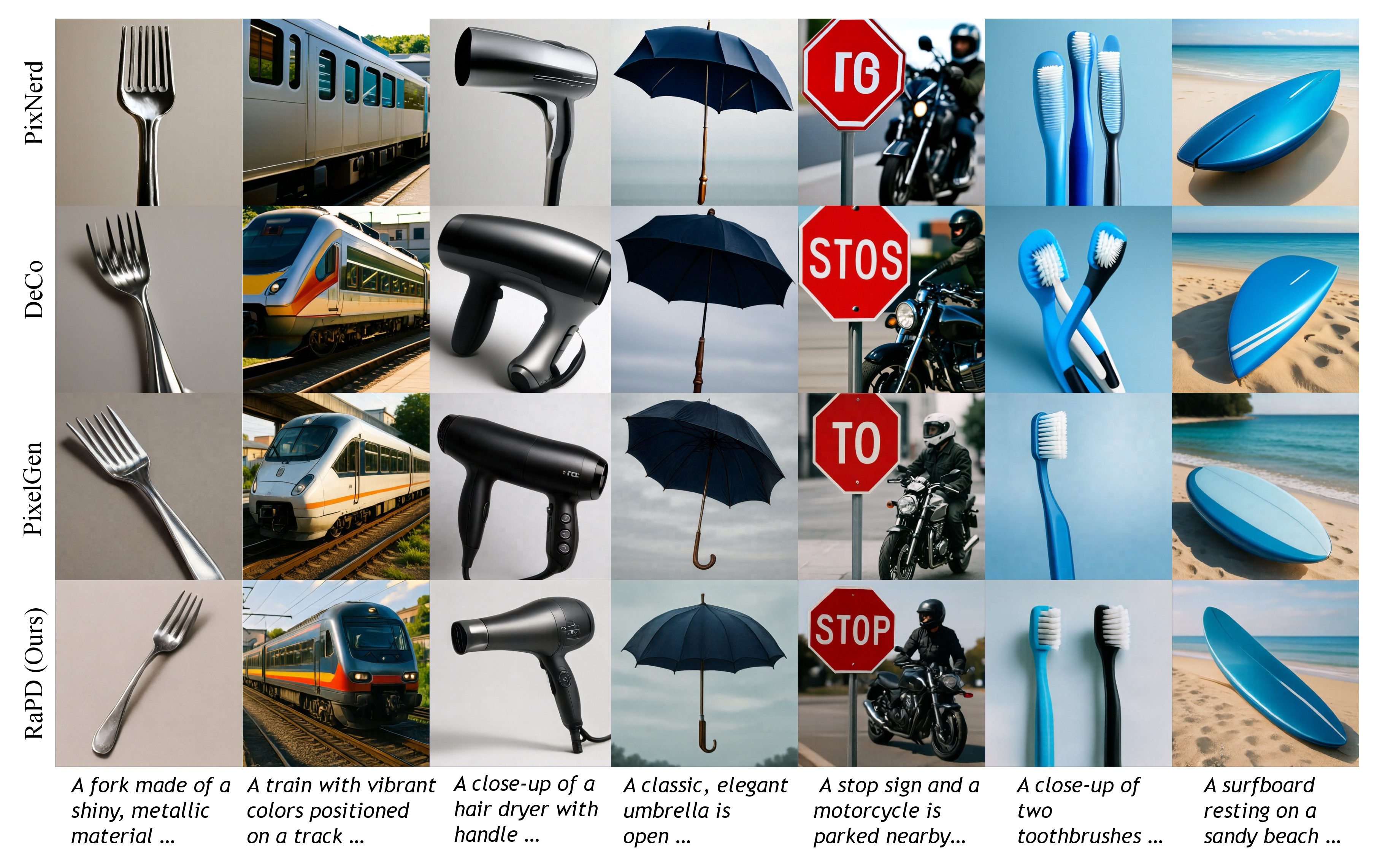
Qualitative comparison with PixelGen, DeCo, and PixNerd at 512 × 512.
Beyond the training resolution
Method
Params
GenEval · 1024²
DPG · 1024²
GenEval · 2048²
DPG · 2048²
SANA
1.6B
0.66
84.8
0.70
83.1
SANA-v1.5
1.6B
0.82
84.5
0.80
83.8
FLUX.1-dev
12B
0.68
83.1
0.66
82.8
RaPD (256→1024)
1.1B
0.85
80.3
0.85
80.1
Progressive 256 → 1024 training. RaPD has the highest GenEval among these methods at both resolutions. Lower DPG scores indicate remaining room for improvement in detailed prompt adherence; 2048² is beyond the 1024² training supervision range.
Fixed diffusion cost. Flexible output size.
RaPD keeps 1,024 denoising tokens across all four output resolutions.
Method
512²
1024²
2048²
4096²
PixelGen
0.19 s
0.60 s
4.72 s
61.46 s
DeCo
0.21 s
0.67 s
5.03 s
62.72 s
RaPD
0.23 s
0.34 s
0.68 s
2.13 s
Per-image inference time on NVIDIA B200. PixelGen and DeCo use 1,024 / 4,096 / 16,384 / 65,536 tokens. Rendering still adds cost as output size grows.
Limitations & future work
Training data scale, the compact Qwen3-1.7B text encoder, and an inference stack that is not yet hardware-optimized remain limitations. Detailed prompt adherence at high resolution also has room to improve.
Future directions include larger training datasets and denoisers, editing and control, and hardware-aware inference with FlashAttention, FP8, and fused kernels.
Citation
@article{ge2026rapd,
  title={RaPD: Resolution-Agnostic Pixel Diffusion via Semantics-Enriched Implicit Representations},
  author={Ge, Yanhao and Guan, Shanyan and Wang, Weihao and Tai, Ying and You, Mingyu},
  journal={arXiv preprint arXiv:2605.15908},
  year={2026}
}